Paris · France
DOOH Paris: the capital's advertising screens, counted and priced
Paris is the only major European capital where an advertising screen is not allowed on the pavement. Since the city's 2011 local advertising rules, digital has moved thirty centimetres back, behind the glass, and gone underground. The network glooh books here has exactly that shape: 7,800+ screens across 2,980+ locations, of which 1,300 sit in shop and pharmacy windows, 1,450 on the metro and 1,000 in the rail stations, and 2,000 at supermarket entrances. Street panels in the classic sense account for 750 screens, mostly outside the ring road. A campaign opens at €250 per week.
Inventory current as of 2026-08
Paris
7,800+ screens mapped
Inventory current as of 2026-08
Explore Paris in the simulator →- 2,600
- Transit
- 2,400
- Retail
- 2,050
- Outdoor
- 350
- Health & beauty
- 160
- Office buildings

1,300
screens across 1,160 locations
The Paris network is behind the glass
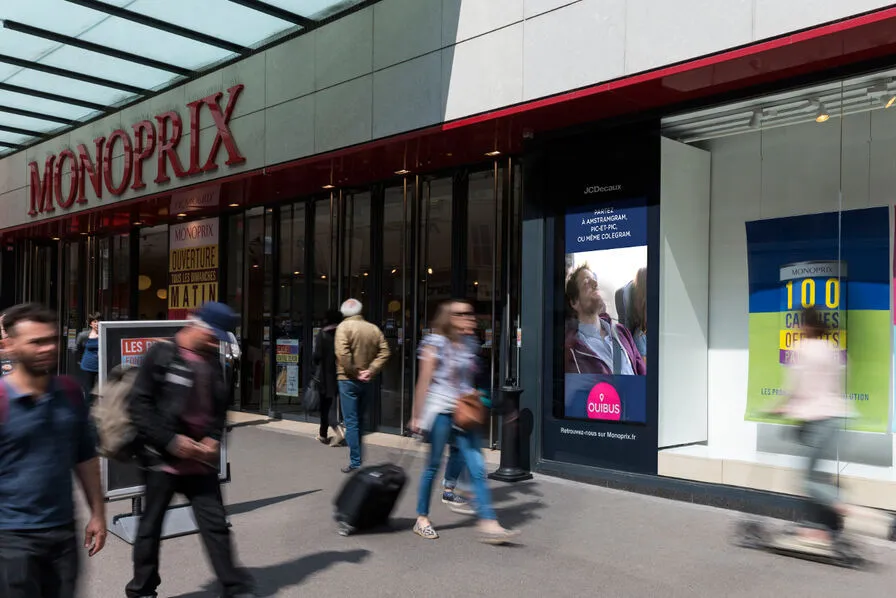
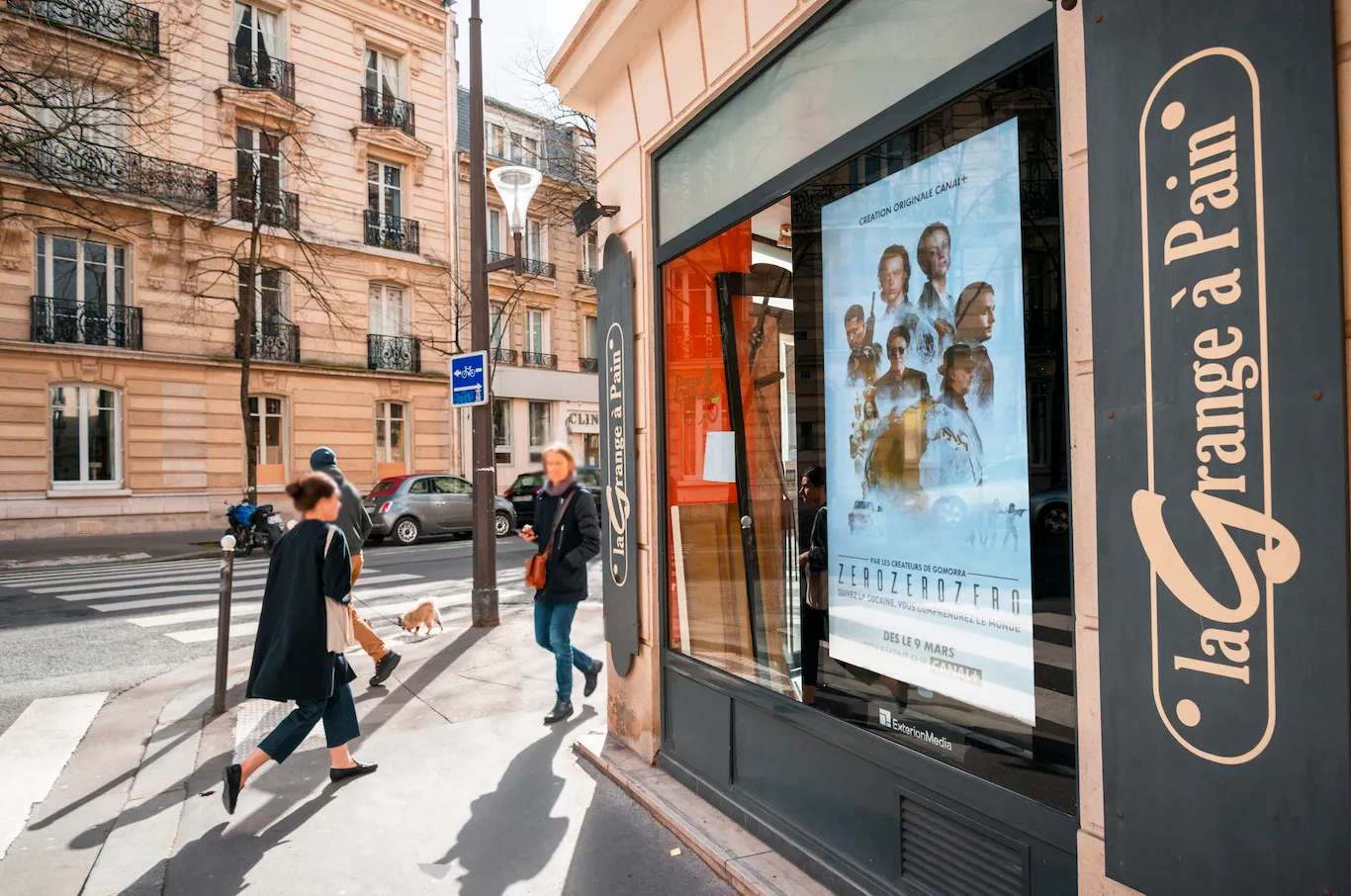
The largest number of locations in the city is neither on the street nor in the metro: it is the shop window. 1,300 screens in shops and pharmacies, lit towards the pavement, on the very streets the 2011 rules closed to digital panels. It is the Paris substitute for the giant crossroads screen: density, not size.
A route, not a screen plan
The method that works in Paris is to follow a day rather than a map. Four contacts with the same message, in four contexts, without ever touching a street panel.
- 01 1,000 screens
Arrival by rail or from the airport
Platforms and halls of the Paris stations, then the metro corridors (1,450 more screens). The first contact, and the longest wait of the day.
- 02 130 screens
The taxi to the hotel
The headrest tablet, forty minutes alone with a single screen. Kabby+ and DooH it.
- 03 1,300 screens
The walk around the district
The windows of Saint-Honoré, Montaigne, the Marais. Favour crossroads: a window at an intersection also catches the people crossing.
- 04 2,000 screens
Shopping, the gym
The supermarket entrance and the fitness club (350 screens). The audience is already inside, basket or gym bag in hand.
Zones across Paris
Each zone is a real catchment: its screens, its venues, its audience.
West Paris (8th, 16th, 17th)
1,390 screens
The business and luxury west, and the largest zone we sell inside the walls: 1,390 screens over 400 venues across the 8th, 16th and 17th. Saint-Honoré and Montaigne windows, the Champs-Élysées galleries, office lobbies around the Étoile, Saint-Lazare on the eastern edge. This is the buy an international brand usually means when it says "Paris".
Points of interest in the zone:
238 schools · 69 universities · 47 gyms · 57 stations · 77 supermarkets · 9 malls

Left Bank (5th, 6th, 7th, 13th, 14th, 15th)
1,350 screens
Six arrondissements and the widest audience mix on the page: 1,350 screens over 540 venues, from Montparnasse and the 15th's grocery network to the 13th's towers and the Latin Quarter. 185 higher-education sites sit inside this perimeter, more than twice any other zone: if the brief says students, it says left bank.
Points of interest in the zone:
409 schools · 185 universities · 82 gyms · 92 stations · 139 supermarkets · 11 malls
La Défense and Hauts-de-Seine
1,320 screens
La Défense and the western suburbs, and the reason this page does not stop at the périphérique: 1,320 screens over 690 venues, the second largest count here. Tower lobbies and the mall at La Défense, then the residential and retail belt through Boulogne, Issy, Levallois and Neuilly. A daytime working population that Paris intra-muros counts as absent.
Points of interest in the zone:
866 schools · 88 universities · 116 gyms · 60 stations · 279 supermarkets · 22 malls
North Paris (9th, 10th, 18th, 19th)
1,220 screens
Two mainline stations, one zone. The 10th alone carries the Gare du Nord and Gare de l'Est complexes, which is why the north holds 1,220 screens over 380 venues with only 4 shopping centres in the perimeter. Around the stations it turns residential fast: grocery entrances and pharmacy counters up through the 18th and 19th, and 296 schools inside the same boundary.
Points of interest in the zone:
296 schools · 66 universities · 59 gyms · 65 stations · 131 supermarkets · 4 malls
East Paris (11th, 12th, 20th)
860 screens
The 11th, 12th and 20th: no landmark shopping street, the most locations per screen of any Paris zone, and a network that lives on neighbourhood retail. 860 screens over 380 venues, with Gare de Lyon and Bercy anchoring the southern edge. The right zone for a brand that wants Parisians rather than visitors.
Points of interest in the zone:
244 schools · 58 universities · 61 gyms · 51 stations · 110 supermarkets · 1 mall
Val-de-Marne
590 screens
South and south-east, 590 screens over 150 venues, with Vincennes and Créteil carrying most of it and 17 shopping centres inside the perimeter. Retail-led, car-borne, and the natural extension of an eastern Paris buy rather than a separate campaign.
Points of interest in the zone:
501 schools · 49 universities · 45 gyms · 37 stations · 149 supermarkets · 17 malls
Central Paris (1st to 4th)
470 screens
The four central arrondissements are the smallest zone on this page and the one that reads most like the rule that shaped the city: no digital panel on the pavement, and behind the glass a dense run of shop-window and pharmacy screens from the Marais through Les Halles to the Palais-Royal. Add the interchange corridors under Châtelet, and you have the tightest perimeter in Paris that still delivers a full day of footfall.
Points of interest in the zone:
75 schools · 36 universities · 34 gyms · 24 stations · 39 supermarkets · 9 malls
Seine-Saint-Denis
460 screens
North and east of the city: 460 screens over 160 venues, concentrated in Montreuil and Saint-Denis. The thinnest of the three ring zones for screens and the densest for schools (626 in the perimeter), which tells you exactly what kind of audience it is: young, local, reached at the supermarket rather than on a boulevard.
Points of interest in the zone:
626 schools · 35 universities · 41 gyms · 45 stations · 147 supermarkets · 15 malls
The neighborhoods where your screens work
Saint-Honoré, Montaigne and the Marais
The window belt. This is where the Paris rule shows most clearly: nothing on the pavement, and behind every second shopfront a lit panel facing the street. For a brand arriving from Tokyo or Shanghai with the reflex of the giant crossroads screen, this is the Paris substitute: density and repetition over a few streets rather than one spectacular board.
The metro and the rail stations
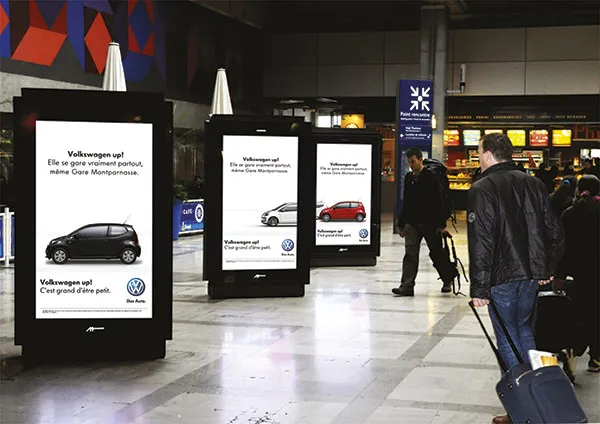
The largest block of screens in the city, and by design the least visible from the street: 1,450 screens on the metro and 1,000 in the stations, on platforms and in corridors where waiting is the norm. The first touchpoint for anyone arriving via Roissy, Orly or Gare du Nord, and the spine of any Paris route.
La Défense and the office districts
Office lobbies carry 160 screens in our capture, mostly one per building, seen twice a day by the same people. Small in volume, precise in audience: executives and decision makers, the public of most B2B briefs.
Supermarkets and shopping centres
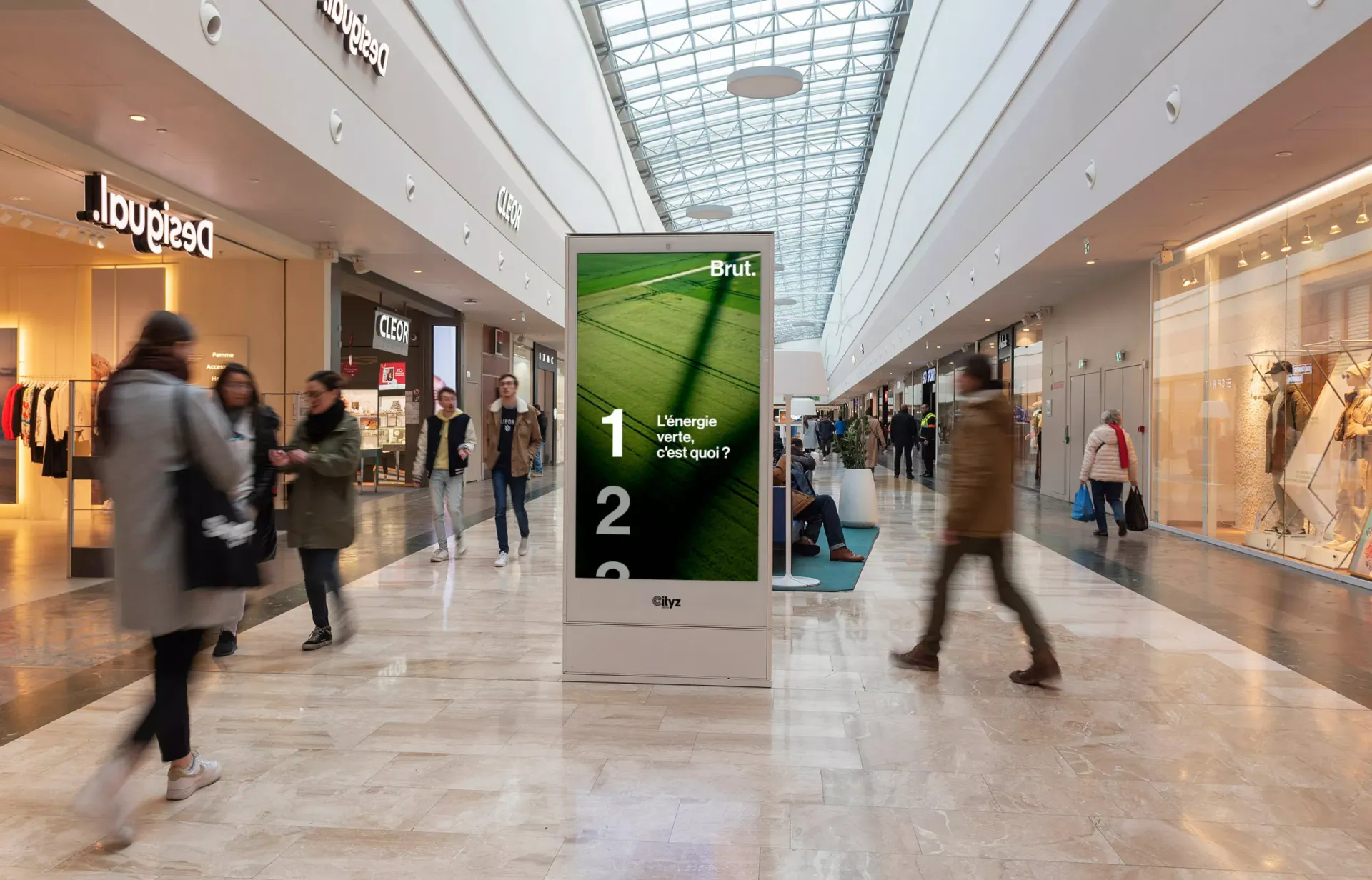
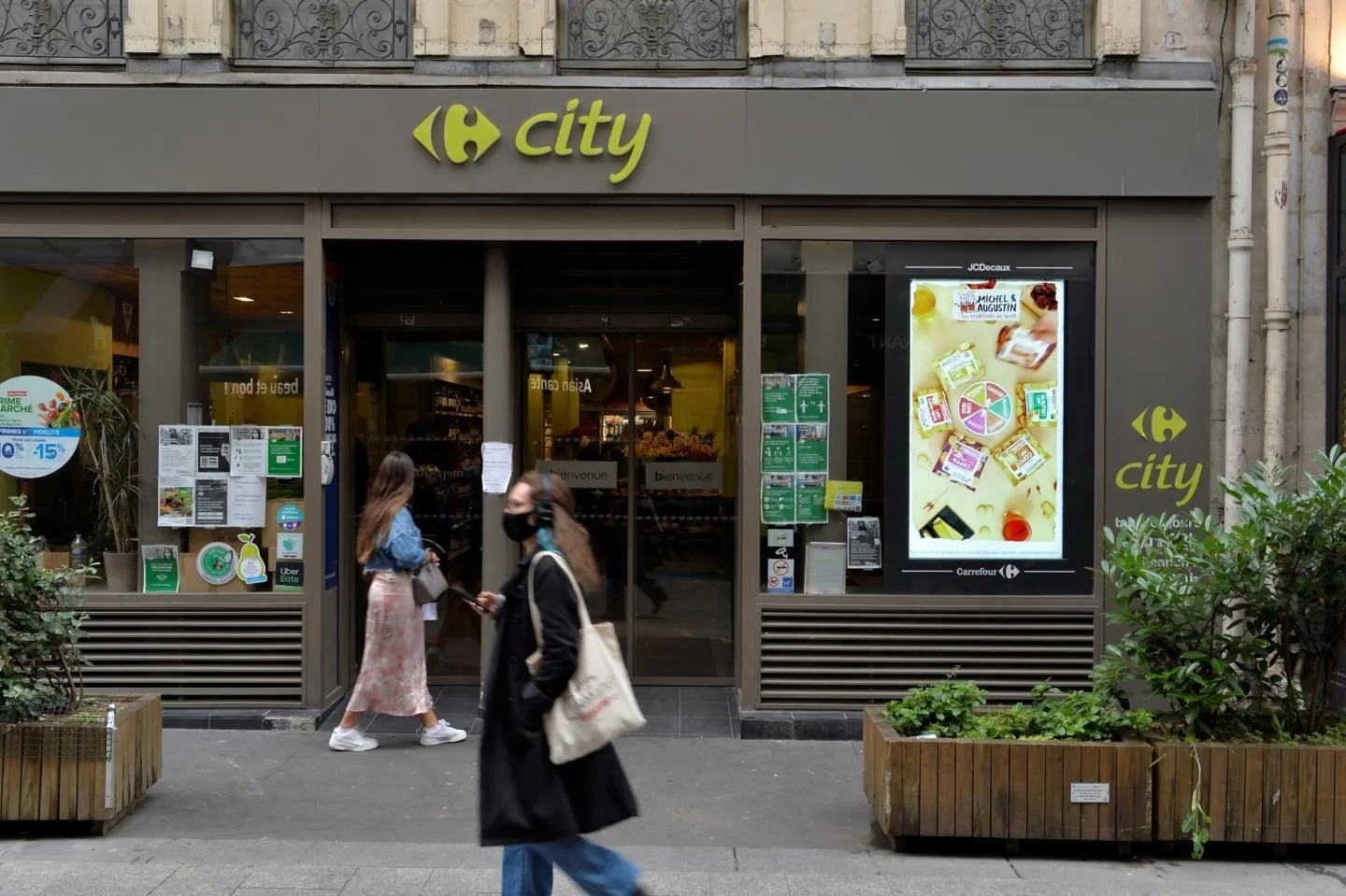
Grocery is the second column of the network, with 2,000 screens at supermarket entrances and in-aisle, plus 400 in shopping galleries. This is where Paris DOOH behaves most like retail media: the audience is already inside, basket in hand.
Gyms and campuses
350 screens in fitness clubs and 250 on higher-education sites. Two audiences the street cannot target cleanly, which indoor screens reach at the source.
In the taxis
130 headrest tablets in Paris taxis and ride-hail cars. The airport-to-hotel ride is the first leg of the route described below, and one of the few moments an international visitor is alone with a screen for forty minutes.
Our screens in Paris

The Paris rules of the game
Outdoor advertising has never been free in Paris: since the Morris column it has been assigned to a piece of street furniture, never to the landscape. The 2011 local advertising rules (the RLP) are the current version. They ban digital advertising panels on the streets of the capital. It is a municipal rule, not a national law, and on its own it explains the shape of the network above: digital settled wherever the rule does not reach, behind a shop window, on a metro platform, inside a shopping gallery. The Climate and Resilience law later let municipalities regulate window screens visible from the street, without banning them, and a separate order requires them to switch off at night. The framework is still moving; we re-read it at every update of this page. For an advertiser the consequence is simple: in Paris you do not buy a giant screen, you buy a mesh.
What a week of DOOH in Paris actually buys
The floor is €250 for one week, the smallest basket that still spreads your creative over several screens instead of parking it on one. Two-week campaigns booked here usually land between €500 and €1300. None of this is a rate card. You set a budget and a radius, the planner fills it from the Paris pool that matches your audience, and you see exactly which locations you got before anything is paid. In Paris that transparency matters more than elsewhere: a week of shop windows around rue Saint-Honoré and a week on the line 1 platforms buy neither the same number of screens nor the same audience for the same money, and neither answer is right for everyone. For a bespoke plan, a seasonal moment, a hand-picked set of streets or an international launch, the sales team builds it with you. For a shop, a chain or a local service, the self-serve platform is enough.
Who operates the screens in Paris
Paris is a many-handed market, which is exactly why buying it piece by piece is slow. Metro platforms and rail stations are run by Mediatransports. Street furniture and part of the window screens are JCDecaux, whose founder Jean-Claude Decaux invented the advertising bus shelter in 1964. Most of the windows and pharmacy counters are a dedicated network, Phenix Digital. Street panels on the outskirts come from Turnadon and Exterion Media, supermarkets from DoohYouLike, shopping centres from Cityz Media, gyms from Basic-Fit, taxis from Kabby+ and DooH it, office lobbies from ECN. Read honestly what this page covers and what it does not. Large digital formats along the ring road, the event installations at Porte de Versailles and Villepinte, and nomadic advertising (LED bikes, trucks, wraps) exist on the Paris market but cannot be booked here today. Nomadic inventory is on our roadmap for the coming months and will join this page when it is bookable, not before. Everything else, 7,800+ screens across roughly ten operators, fits in one basket, one creative upload, one invoice.
Renting time on a Paris screen is not buying a screen
Search for "écran publicitaire Paris" and half the results will try to sell you hardware: a panel to fit inside your own shop window on rue de Rivoli, installation included. That is a completely different purchase, and it is not this. What is on this page is airtime on screens that already exist and already have an audience walking past them, in the 2,980+ locations plotted on the map above. Nothing gets installed, nothing gets owned, the shortest commitment is seven days, and the creative can change mid-flight. If you are on the other side of the trade, a Paris shop owner with a busy window and a screen to monetise, that is the partner route rather than this one.
What a foreign advertiser would not guess
- Digital panels are banned on the streets of Paris by a 2011 municipal rule, not by national law. The framework is revised regularly.
- Advertising shown in France must be in French, or carry a legible French translation (the Toubon law).
- Window screens switch off at night, by decree.
- Wild posting around the fashion shows is illegal; it is not an option.
Rules checked on 22 August 2026
Frequently asked questions
- How much does a DOOH campaign in Paris cost?
- Paris opens at €250 per week, and the usual two-week bracket runs from €500 to €1300. That is aggregate campaign pricing across the whole Paris pool, not a per-panel rate card, and it includes delivery of a standard creative. No annual contract, no agency retainer. A bespoke plan for a seasonal moment is priced with the sales team.
- How many advertising screens does glooh actually have in Paris?
- 7,800+ screens across 2,980+ locations, counted from live inventory rather than estimated. A location is a bookable address: a metro station counts as one location and several dozen screens, a pharmacy as one location and one screen. By venue type: 2,600 in transit, 2,400 in retail, 2,050 outdoor and in windows, 350 in gyms and health, 250 on campuses, 160 in office buildings.
- Can I book only the rue Saint-Honoré area or the Marais?
- Yes. The planner works by radius and address, not by whole city: drop a pin on rue Saint-Honoré, set a distance of a few hundred metres and a budget, and the selection contains only the windows and screens inside that perimeter. That is the natural shape of a Fashion Week presence, dense over a few streets rather than thin over twenty arrondissements, with a booking window to plan several weeks ahead.
- Why are there no giant screens on the streets of Paris?
- Because the city's local advertising rules have banned digital panels on public streets since 2011. It is a municipal rule, not French law, and it is revised regularly. Digital therefore lives in shop windows, on the metro, in stations and in everyday venues, which is exactly what this page books. Wild posting around fashion shows, common as it is, is illegal and is not an option.
- Can I book the metro and rail station screens here?
- Yes. 1,450 screens on metro platforms and in corridors and 1,000 in the Paris rail stations, operated by Mediatransports, bookable in the same basket as the windows and supermarkets. They are the screens with the longest dwell time in the city.
- What about taxis?
- 130 tablets in taxis and ride-hail cars, through Kabby+ and DooH it. It is a visitor's first contact between the airport and the hotel, and a format we pair with the windows of the arrival district to get two exposures inside an hour.
- Do you cover the inner suburbs or only Paris inside the ring road?
- The capture radius of this page goes beyond the périphérique. Street panels in the classic sense, 750 screens, are in fact mostly in the suburbs, where the Paris rule does not apply, and the inner-suburb supermarkets are part of the pool. For a business in Boulogne, Montreuil or Saint-Denis, drop the pin on your own address and the planner keeps only what is around it.
- How fast can a Paris campaign go live?
- Same-week is normal. You build the campaign against the live Paris inventory, upload a visual, and the screens pick it up on the next scheduling pass. The slow part in this market has never been the technology, it is getting quotes back from ten different operators between the metro and rue Saint-Honoré.
Want proof? See real campaigns · How pricing works
Other cities in France
Your screens in Paris are waiting
Pick a neighborhood and a budget, and see your campaign before you pay a thing.